Some brief considerations about

Showing posts with label BOOKS. Show all posts

Sunday, May 8, 2016

How Rare Is the Earth? Interview of Peter Ward on Sept 2011


  • Posted 10.21.11
  • NOVA
What are the chances that there are many other planets in the universe as hospitable to intelligent life as ours? Peter Ward, a paleontologist at the University of Washington and coauthor (with Don Brownlee) of Rare Earth: Why Complex Life is Uncommon in the Universe, argues that while simple life-forms like extremophiles can exist in harsh conditions, complex life requires much more benign and stable conditions. As a result, Ward believes that we are effectively alone in the universe.

img tag

Peter Ward is a paleontologist and professor of Biology and of Earth and Space Sciences at the University of Washington. He is the author of many popular works, including more than a dozen books. Ward is currently researching the nature of the Cretaceous-Tertiary extinction event. EnlargePhoto credit: Courtesy Peter Ward/NASA

Interview of Peter Ward conducted in September 2011 and edited by Lauren Aguirre, Director of New Media for NOVA

ALONE OR JUST LONELY?

NOVA: What first got you thinking about the possible existence of alien intelligence?

Peter Ward: Well, who isn't, actually? I mean, what person really isn't thinking at least about ourselves and our aloneness or not? We are so immersed in aliens, you can't get away from it. I would say that the top four of the 10 greatest box office hits of all time were dealing with alien life in some way or another. And somewhere along the line you have to start asking yourself, well, what are the chances?

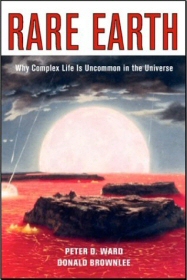
Rare Earth: Why Complex Life is Uncommon in the Universe / Peter D. Ward and Donald Brownlee


Free PDF available at


Reviewed by Tal Cohen

Monday, 26 November 2001

It is said that one of the most important skills a physicist needs is the ability to quickly make “back-of-the-envelope” calculations. For example, Jan Wolitzky (in Jon Bently'sProgramming Pearls) tells about Enrico Fermi, Robert Oppenheimer, and the other Manhattan Project brass who were behind a low blast wall awaiting the detonation of the first nuclear device from a few thousand yards away. Fermi was tearing up sheets of paper into little pieces, which he tossed into the air when he saw the flash. After the shock wave passed, he paced off the distance traveled by the paper shreds, performed a quick “back-of-the-envelope” calculation, and arrived at a figure for the explosive yield of the bomb, which was confirmed much later by expensive monitoring equipment.

trevor james constable

LIGHTEYE